
A cleaner shouldn’t ask you to trust a black box.
Mac Cleaner Pro deletes files on your Mac, so “trust us” isn’t an acceptable answer. Here is exactly what it’s allowed to touch, and what stops it touching anything else — each of which you can verify in the source.
Nothing is deleted outright
Every removal is a move into ~/.Trash/MacCleanerPro/<UUID>/ — a rename, not a copy. Nothing is ever rm -rf'd, including by the developer-junk scanner. If you disagree with a clean, the files are still there.
Undo survives quitting
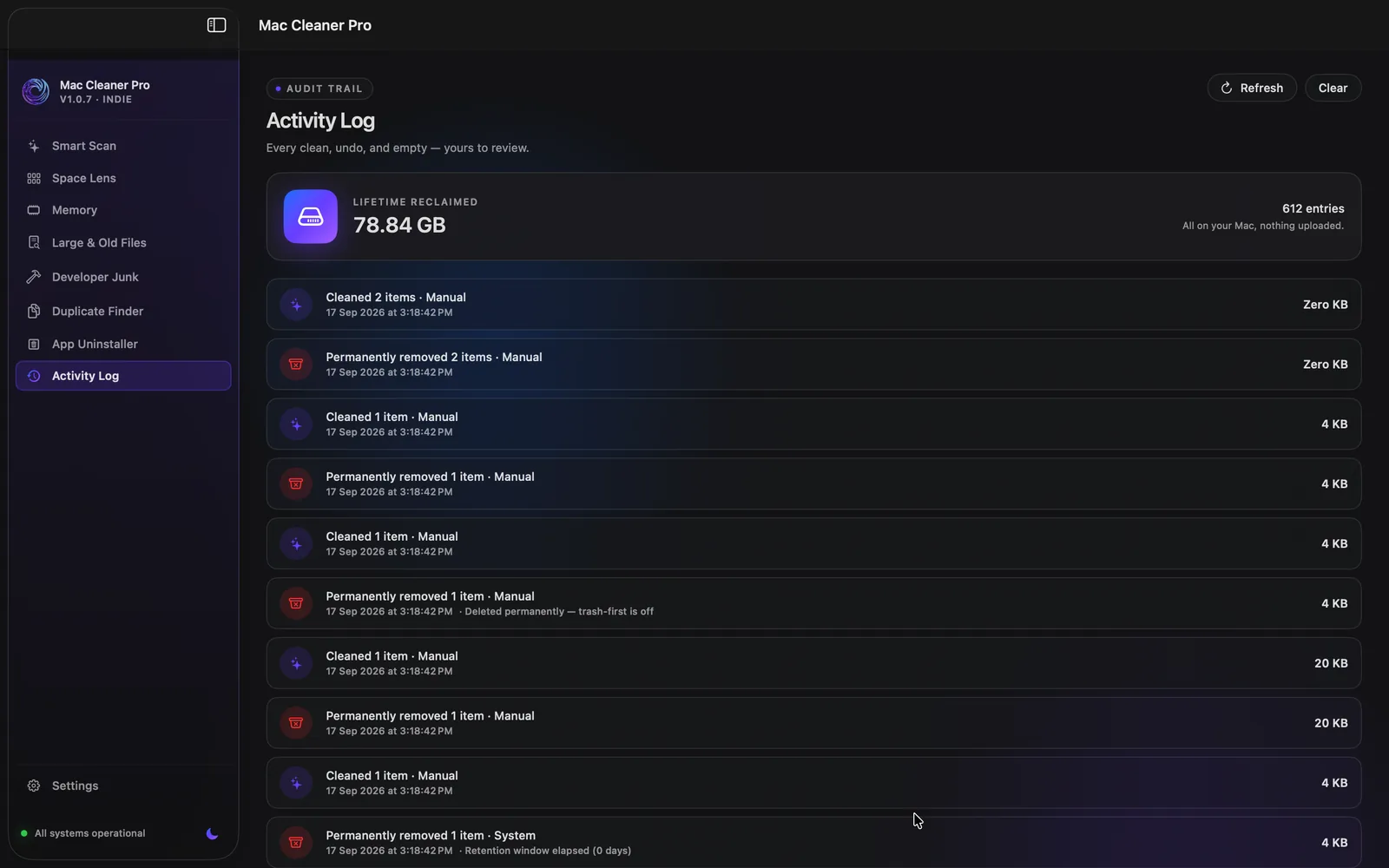
Each cleanup writes a token that is persisted outside the Trash and reloaded at launch, so you can revert from the Activity Log days later. Staged files stay recoverable for 30 days.
Rules are signed before they're trusted
The rule pack decides which files may be deleted, so it is Ed25519-signed and verified against a public key compiled into the app. A tampered pack is rejected outright rather than falling back to an unsigned copy.
System paths are off limits
The scanner refuses to descend into /System/, /Library/, /Applications/ or ~/Library/, even if you hand it one as a root. Symlinks are never followed, so a link can't be used to reach a protected path.
Artefacts need proof they can come back
A build folder is only offered as safe when the tool that made it is still there — node_modules beside a package.json, target beside a Cargo.toml. 11 of the 21 detectors require that confirmation; the rest are toolchain caches, and anything unconfirmed is flagged review-recommended rather than pre-ticked.
Some caches cost more than they free
Cleaning user caches skips 17 Apple caches by name — Safari webpage previews, CloudKit, Photos, Contacts, Music, TV, Mail, Notes, Find My, News, Maps, Spotlight suggestions and iCloud sync among them. Deleting those buys little disk and costs re-downloads and re-indexing.
Check it yourself
None of the above has to be taken on trust. The cleanup rules, the exclusion list, the signing workflow and the deletion service are all in the public repository.
- RulePacks/v1.json — all 21 rules and the 17-entry exclusion list
- SECURITY.md — the full security model
- docs/rule-pack-signing.md — how rule packs are signed and verified
One thing we can’t yet claim: the app is not notarized by Apple, because that needs a paid Developer Program membership. Every release publishes a SHA-256 checksum instead. Installing, step by step →